‘Just one damn thing after another’ is an amusing portrayal of historical narrative. It also applies rather neatly to Britain’s past decade or two of almost continuous economic disaster. Since the late 2000s, the country has lurched from the fall of Northern Rock and the global financial crisis through the self-inflicted economic pain of austerity and Brexit in the 2010s to the recent unavoidable hits to incomes and wellbeing from the Covid-19 pandemic, Russia’s invasion of Ukraine, conflict in the Middle East and the ensuing surge in food and energy prices.
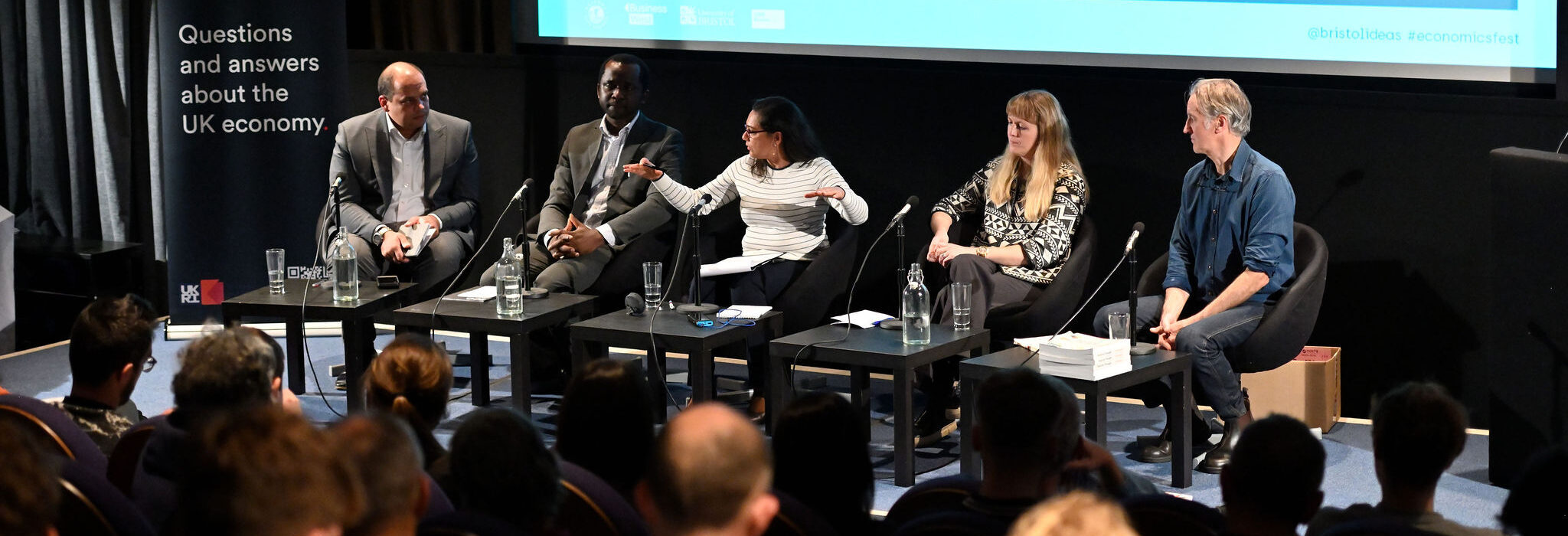
“What is the Future of Food in the UK?” Panel Discussion, Watershed Bristol (Festival of Economics 2023)
All of this takes some explaining to the British people, whose lives and livelihoods have been so affected. That’s a task to which the Bristol festival of economics has sought to make a local and national contribution over the past 15 years with an annual series of public events bringing together economic experts from universities, thinktanks, the private sector and the media with policy-makers, practitioners and West Country residents keen to understand what’s going on.
The 14 editions of the festival since 2012 have covered an enormous range of topics – including the economics of climate change, new technology, geopolitical tensions, food security and the ageing society. It’s welcomed many of the economics profession’s top thinkers, policy officials and media stars – including Nobel laureates Angus Deaton and Jean Tirole, Bank of England policy-makers Swati Dhingra, Andy Haldane, Mervyn King and Huw Pill, and journalists Stephanie Flanders, Chris Giles, Tim Harford and Linda Yueh. And speakers have spanned the generations – from the youngest panellist, school student and Bristol youth mayor Alice Towle, to octogenarian writer and feminist Katharine Whitehorn.
“Each year the Festival of Economics delivers insightful debates on key topics. You can always rely on Bristol for interested and engaged audiences. This is your opportunity to hear top quality economic analysis in the context of what’s happening outside models and in the real world in Bristol, the UK and beyond.”
– Chris Giles (Financial Times)
The annual gathering attracts large and highly engaged audiences, not least big numbers of young people from local schools and universities. By making economics relevant to their futures, the festival provides valuable support for initiatives to address the uncomfortable fact that for many years in this country, students of the subject have been disproportionately male, white and privately educated. It also helps economic policy-makers in their efforts to listen directly to the public’s concerns about jobs, pay and the cost of living – not least in the Bank of England’s citizens’ panels that have opened the festival for the past few years.
Two people have underpinning the festival’s success. One is economic scholar and commentator Diane Coyle, who on returning from a festival of economics in Trento, Italy, in the summer of 2012, asked on Twitter why no such civic event happened in Britain. The other is Bristol Ideas founder Andrew Kelly, who picked up that challenge, replying: ‘you programme it and we’ll organise it!’ The rest, as they say, is history – a popular annual forum for promoting the public understanding of economics and debating issues of broad social concern.
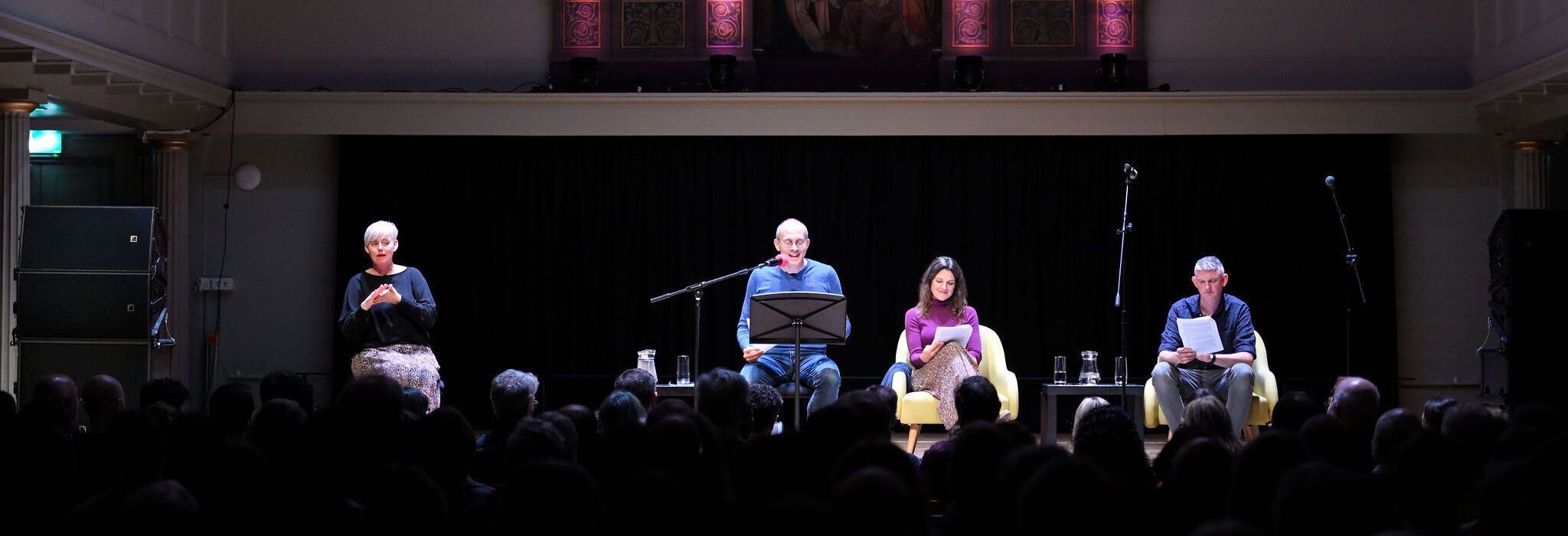
Tim Harford: Cautionary Tales Live Podcast, St. Georges Bristol (Festival of Economics, 2023)
Back then, it seemed laughable to think that there was a connection between the words ‘festival’ and ‘economics’. Now, their combination has become a widely known and highly regarded fixture in the calendar for economists and the public – not perhaps as inexorably intertwined as ‘economic’ and ‘crisis’, but it’s getting there. The week beginning 16 November 2026, we will be hosting our 15th edition: please do sign up to our email list if you would be interested in finding out more.
Photo Credits: Bhagesh Sachania Photography
Festival Team
The Festival of Economics is organised by: